Operations
Metalero’s Projects
Bolivia Projects
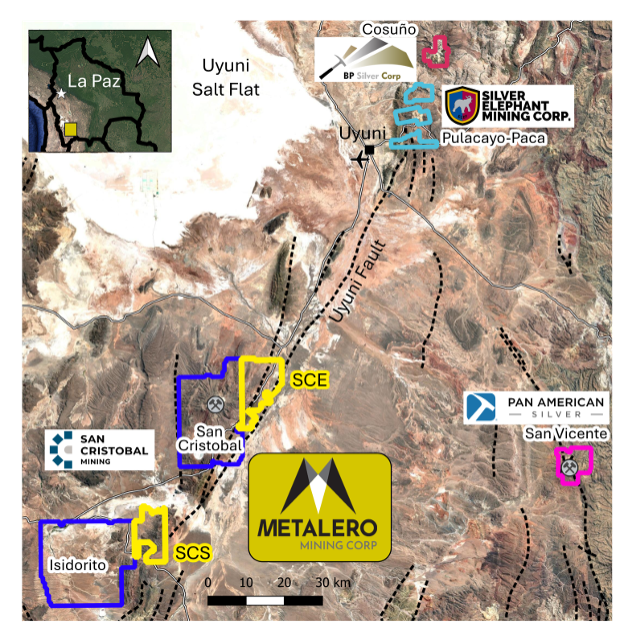
Positioned adjacent to the world-class San Cristobal Mine, Metalero’s district-scale Bolivia projects target large-scale silver systems along the highly prospective Uyuni Fault System in one of South America’s most underexplored mineral belts.
The San Cristobal East (SCE) and San Cristobal South (SCS) projects comprise a district-scale ~230 km² land package in southwestern Bolivia, directly adjacent to the world-class San Cristobal Silver-Lead-Zinc Mine and the Isidorito silver prospect. The projects lie along the regionally significant Uyuni Fault System and overlie the same prospective geology and large-scale structural corridors associated with the San Cristobal, Pulacayo-Paca, and Cosuno silver systems.
Metalero entered Bolivia as an early mover into one of South America’s most underexplored mineral jurisdictions, where approximately 60% of the country remains unmapped or underexplored. Initial targeting has identified strong potential for large-scale silver systems, with upcoming exploration focused on mapping, geochemistry, geophysics, and alteration targeting across this highly prospective emerging district.
Metalero is preparing to commence the first modern exploration programs across its SCE and SCS projects in southwestern Bolivia. Located along the regionally significant Uyuni Fault System (“UFS”), the projects are positioned within 5–6 km of the world-class San Cristobal Mine and the Isidorito silver prospect, highlighting the strong geological potential of the district. Initial exploration will include detailed rock and soil sampling, geological mapping, and potential ground geophysical surveys designed to identify zones of hydrothermal alteration and sulphide enrichment associated with the UFS. Metalero also plans to complete an airborne geophysical survey to better define regional structures, trace prospective geology, and generate high-priority drill targets through the identification of conductivity, chargeability, and magnetic anomalies linked to mineralization.
Benson Project
Benson is drill-ready and located within a prolific copper-gold belt, with multiple large-scale targets showing analogues to major producing deposits.
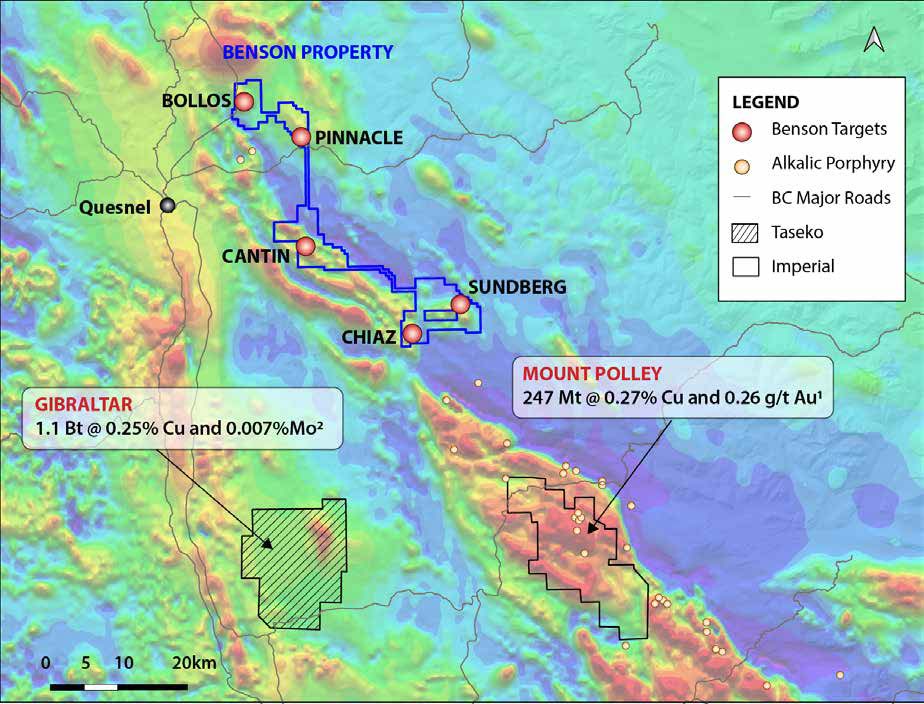
Highly analogous to Mt. Polley and Mt. Milligan deposits, the Benson project is underlain by the same Triassic-Jurassic intrusive suites and large-scale fluid-conduit structures. The property includes 166 km² of road-accessible terrain just 15 km east of Quesnel, British Columbia, in the heart of the Quesnel porphyry belt.
Major mining companies are already active in the area, with Fortescue recently staking over 4,000 km². Historical data and modern geophysics support the presence of multiple Cu-Au targets, making this a compelling underexplored discovery opportunity
Located along trend from Mt. Polley and only 30 km northwest of it, the Benson property contains several high-potential zones identified through AI-assisted targeting by Geoscience BC. The property features:
-
Gossanous intrusives with porphyry-style alteration
-
Historic drill intercepts up to 1.4 g/t Au over 11m
-
Broad-scale magnetic and geochemical anomalies over multiple km-long trends
-
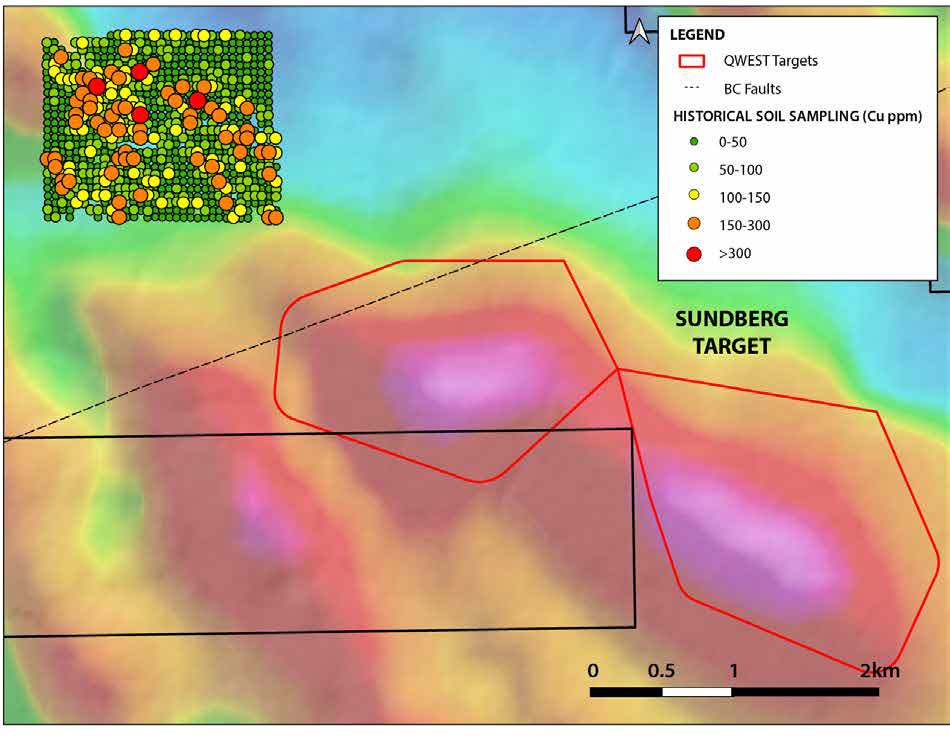
Priority areas include Cantin (9 km anomaly) and Sundberg (4.5 km anomaly)
These targets are analogous to mineralization types typically found at large porphyry systems in the region.
6Well-defined correlations between magnetic anomalies, mapped structures, and geochemical signatures define the drill targets. Historical drilling has already confirmed gold values over wide intervals, but copper assays were historically limited or absent.
-
Permitting is underway
-
Initial drill program is expected to begin in Spring 2026
-
Five high-priority zones will be tested across multiple phases
The strong potential for a Cu-Au porphyry discovery beneath the shallow cover makes Benson one of the most prospective, underexplored properties in the belt.
Cantin Target
- 9 km long geophysical anomaly
- Gossanous intrusive rocks and soil anomalies in the area
- Epithermal- and skarn-type mineralization drilled historically – both of these are associated with porphyry deposits
- Historical drill logs recorded copper minerals, porphyry-style alteration but copper analyses were rare

Sundberg Target
- 4.5 km long geophysical anomaly
- Copper and gold in soil anomaly down-ice to the northwest
- Altered and mineralized volcanic rocks identified